 18 Jun 2026
What Kind of Beast is Similarweb? The No-Bullshit Digital Intelligence Guide
Stop scaling in the dark. Learn how to weaponize Similarweb for analysis of competitors, bypass the 2026 data privacy blackout with predictive AI modeling, and translate raw market intelligence into a multi-channel growth engine that chokes out your rivals.

⚡ Key Takeaways
Detect directional shifts, don't count pennies. Advanced growth teams do not use market intelligence platforms to build financial accounting spreadsheets. We use them to detect directional shifts. Stop fighting your internal Google Analytics over a 30% numbers mismatch—the real value lies entirely in uncovering relative market leverage and distribution ratios.
Choose the right lens. Platforms like Semrush hunt inside the search engine box. Similarweb tracks the entire human digital ecosystem outside of it—mapping direct visits, dark social, display networks, and cross-browsing affinity.
Exploit traffic dependencies. Intercept rivals hooked on a high-cost paid traffic IV drip by deploying authoritative organic content clusters instead of engaging in stupid, cash-burning PPC bidding wars.
Operate with surgical focus. Enterprise vanity metrics are noise. Use Segment and Folder Analysis to slice away the corporate data bloat and surgically audit the exact product directories threatening your specific market share.
Trust the predictive model. In the 2026 post-cookie privacy blackout, you aren't purchasing stolen server logs. You are leveraging an advanced, machine-learning-driven simulation that accurately reconstructs missing competitive intelligence.
Look, in this digital Wild West, there are two kinds of marketers. The ones who sit by the campfire, staring at their internal Google Analytics, praying that Meta’s latest algorithm tweak won't kill their margins tomorrow. And the ones who pull out a high-caliber optic scope to count the exact number of rounds left in the rival's magazine. Similarweb is that optic scope. But let’s be completely honest for a second: is it actually the "similar web" it claims to be, or are we just looking at a brutally expensive oracle with a brilliant marketing team? Could it be any more hyped?
Let’s strip away the corporate romance right now: no third-party software on earth has a direct API connection to your competitor’s backend. Remember that, and repeat it to your team before your next strategy session. The moment an agency or a fresh-faced marketer assures you that Similarweb shows absolute, down-to-the-last-click traffic numbers of your biggest rival—tell them to step away from the keyboard. It doesn't work that way.
Similarweb operates like a highly sophisticated spy network. They don’t hack dashboards; they compile a composite sketch. They deploy massive panel data sets from millions of real users with web extensions, buy anonymous clickstream data from internet service providers, and unleash an army of web crawlers. They dump this entire chaotic mess into a massive cloud engine and blend it with machine learning estimation models. What you get on your screen isn’t an X-ray; it’s a terrifyingly accurate police sketch. And to win a war for market distribution, that sketch is more than enough.
The amateur mistake is comparing Similarweb numbers directly to your internal GA, spotting a 30% variance, and throwing a tantrum. If you’re hunting for absolute mathematical precision here, you brought a knife to a gunfight. The true value of this tool lies entirely in relative trends and distribution ratios. If the system tells you Competitor A has a million visits and Competitor B has a hundred thousand, the real numbers might be higher or lower—the proportional relationship and relative market leverage are often far more reliable than the absolute numbers themselves. You see the heavyweights, you see who is gaining ground, and you see who is just noise.
The Macro Umbrella: Category Benchmarking and the Ad Intelligence Play
Before you grab a digital scalpel and start picking apart a single rival's keyword list, you need to understand the macro environment. Most performance marketers make the rookie mistake of focusing exclusively on one competitor's poker face while completely missing the fact that the entire casino is changing its rules. Similarweb’s true superpower—its massive strategic umbrella—is Industry and Category Benchmarking. It allows you to zoom out and map the entire ocean before you decide which whales to harpoon.
Instead of guessing, you can analyze the total market share distribution across an entire sector—say, the B2B Cloud Servers Hosting market in Western Europe or E-commerce tech in North America. You instantly see the overall traffic tides, historical seasonality shifts, and whether the market is consolidating under a monopoly or fracturing into agile niches. This is where your long-term growth architecture is born.
Once you know where the industry tide is moving, you look at how those entities buy their way into market mindshare via the Ad Intelligence layer. Now, let’s keep it real: if you are looking for pixel-perfect ad creative mapping or hyper-granular format tracking, specialized ad-ops software like Semrush AdClarity might give you a sharper, narrower knife for creative copy.
But Similarweb doesn't care about pretty banners; it tracks the programmatic distribution weight. It unmasks the exact ad networks your rivals are dumping cash into—whether it’s Google Display, Taboola, or Outbrain—and charts the actual traffic volume generated by those placements. It doesn't just show you what the ad looks like; it tells you if that specific media budget is moving the market needle or just lighting client cash on fire.
Similarweb vs Semrush: Choosing Your Weapon for Total Market X-Ray
Sooner or later, the day comes. You’re sitting there balancing two open browser tabs, while your financial director looks at you like you just asked to clear a multi-thousand-dollar check for a magic trick. We need to settle the Similarweb vs Semrush debate once and for all. This isn't about which UI looks cleaner; it’s a fundamental conflict between two entirely different espionage philosophies.
Most growth teams confuse these platforms because both have "competitor analysis" slapped on their features page. Let’s look under the hood. Platforms like Semrush or Ahrefs are world-class search engine bloodhounds. They live inside Google's database. They track keyword positions, monitor SERP updates, and estimate traffic based on search volume and static CTR curves. They know everything about the search bot, but they are completely blind the moment a user leaves the Google search bar.
This is exactly where Similarweb completely changes the game. While search bots see keywords, Similarweb tracks the actual human digital ecosystem. Direct visits, dark social, referral partnerships, native display ads, email campaigns—it maps the entire distribution web. Trying to evaluate a major rival's market footprint using strictly Semrush is like trying to analyze an entire movie plot by looking exclusively at the theater poster. Could that be any more short-sighted?
If your business relies 100% on pure SEO and deep semantic content factories, Semrush will give you a tighter keyword map and backlink profile. But if your mandate is to architect a dominant growth engine, discover exactly where your competitors are poaching their real conversions, and map their cross-channel loops, Similarweb stands entirely alone. They aren't substitutes; they are different layers of market intelligence.
📐 The Distribution Arbitrage Framework (DAF): Turning Raw Intelligence into Execution
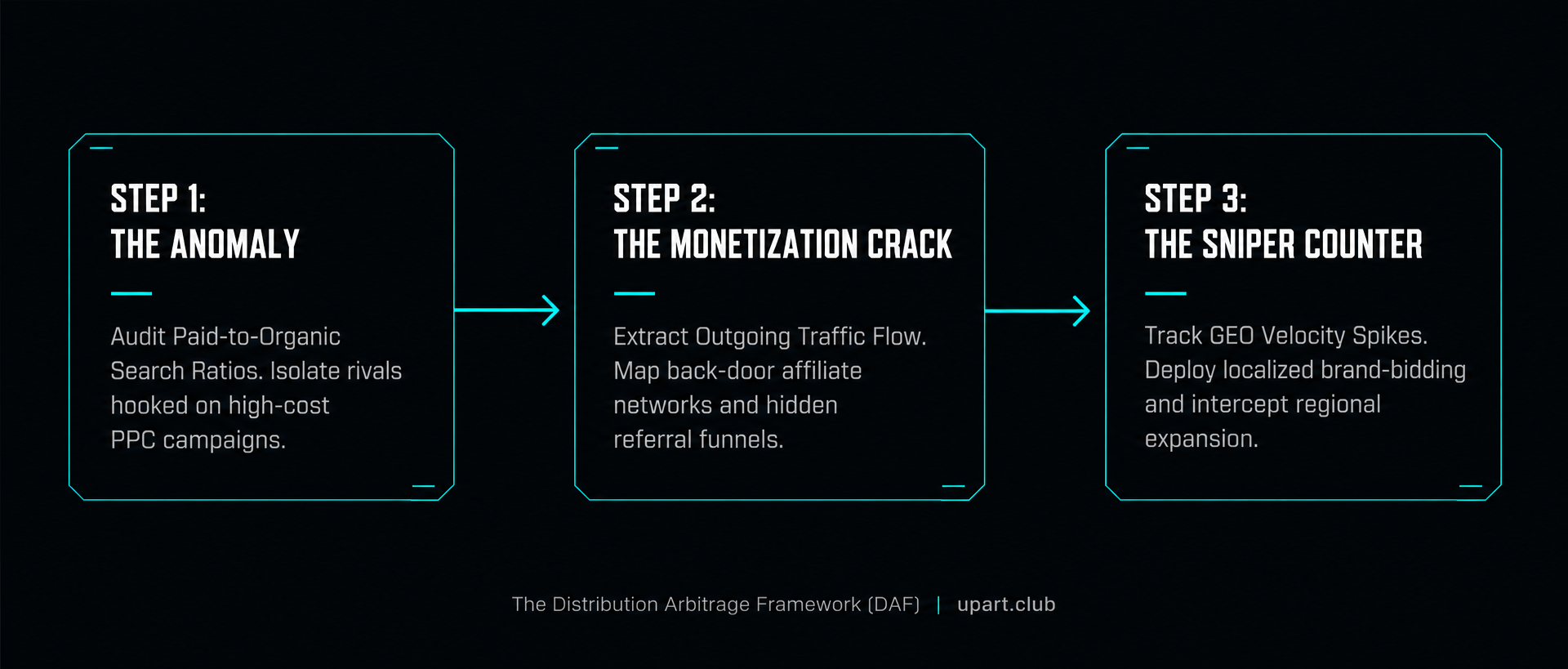
To analyze competitors without drowning in useless analytics routines, you need a repeatable system. Growth teams shouldn't just look at charts; they should look for structural anomalies. This is what I call The Distribution Arbitrage Framework (DAF)—a three-step competitive intelligence sprint designed to translate raw metrics into explicit execution commands.
📁 Case File: Intercepting the Ad-Addicted Competitor
To see this in action, let's look at an anonymized audit I recently ran for a mid-market B2B SaaS platform in the cloud infrastructure space. Their primary competitor was dominating share of voice, but a quick dive into Similarweb’s Search Traffic -> Paid vs. Organic split unmasked a massive structural flaw:
The Rival's Traffic Mix: 74% Paid Search (PPC) vs. 26% Organic.
The Burn Rate: They were spending an estimated $85k/month just to maintain their core transactional keyword footprints.
The Vulnerability: Their organic infrastructure was practically non-existent—no deep content clusters, zero programmatic SEO pages, and a terrible toxic backlink profile.
The Tactical Play: Instead of engaging in a suicidal, cash-burning PPC bidding war that would inflate our own CAC, we mapped their top-converting paid keywords via the Paid Keywords report. We then deployed an aggressive programmatic SEO engine, building high-authority, hyper-targeted landing pages addressing those exact search intents.
Within two quarters, we captured 35% of their organic market share for free, while their rising CPC costs eventually forced them to scale back their ad spend—effectively cutting their lead velocity in half.
Here is how to deploy the Distribution Arbitrage Framework across your target's ecosystem:
Step 1: Audit the Paid-to-Organic Ratio. Open the Search Traffic section, completely ignore the aggregate vanity volume, and look straight at the baseline distribution channels. If the data mirrors our case file above, you have found your target's soft underbelly. Your exact counter-move here is to download their entire paid keyword list, sort it by traffic volume, and hand it to your content architects. You aren't buying the traffic; you are stealing the intent.
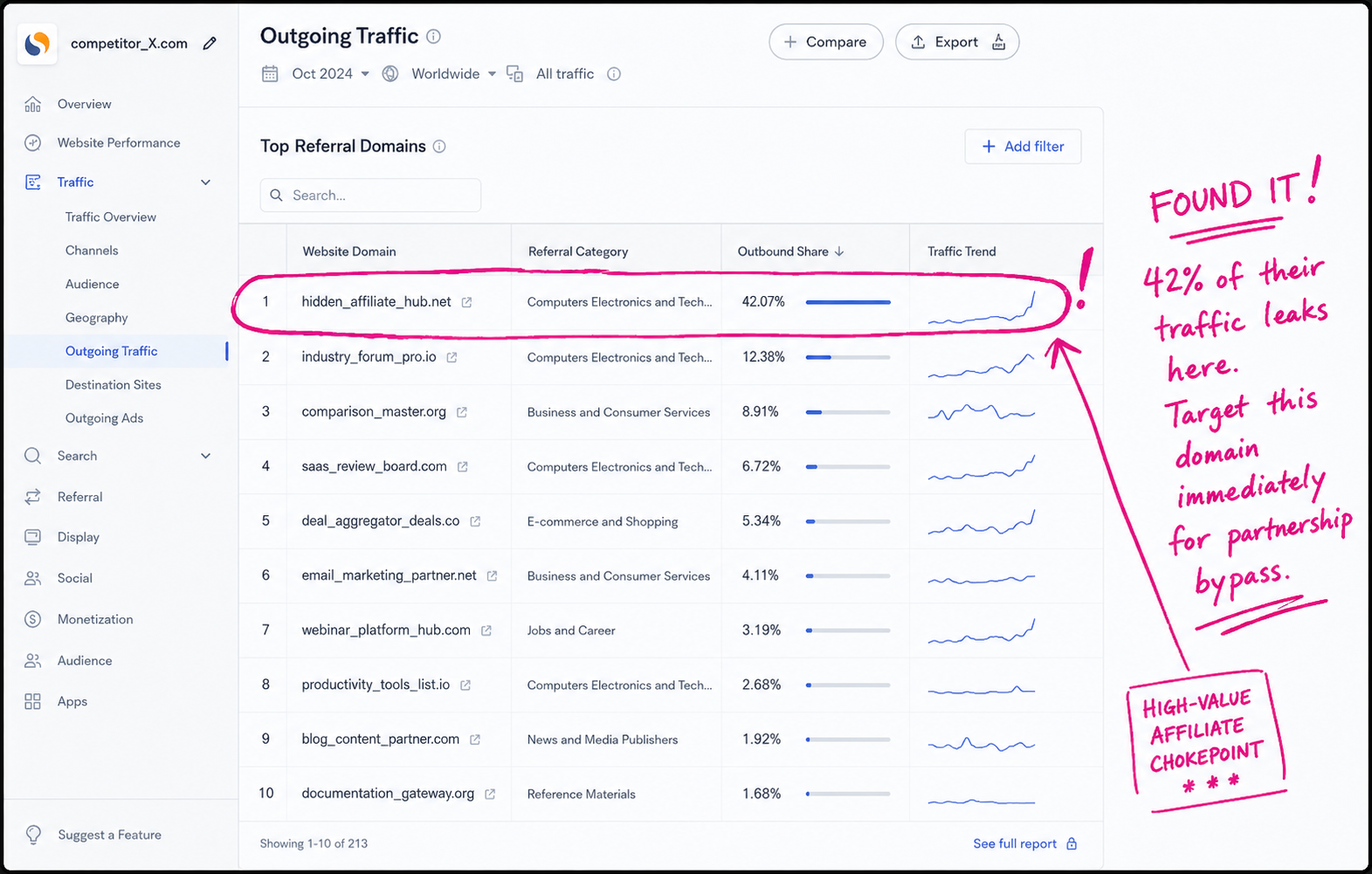
Step 2: Weaponize Outgoing Traffic Flow. Next, dive deep into the Outgoing Traffic dashboard. Almost nobody spends time here, which is a massive tactical waste. You are tracking exactly where users go immediately after leaving your competitor's site. If the top outgoing URLs reveal specific affiliate networks, niche comparison portals, or unlisted partner domains, you have just cracked open their entire monetization and back-door affiliate structure. This is a ready-to-use target list for your business development team—go to those exact referral sites and offer them a cleaner integration or a better margin to hijack their pipeline.
Step 3: Intercept Regional Land Grabs. Finally, monitor their international velocity via GEO Distribution details. If a competitor suddenly registers a 40% month-over-month traffic spike from a specific country, they aren't just getting lucky—they are actively deploying a localized market-entry test. Cross-reference this by checking their localized ad copy and dedicated landing pages within the platform. Your growth team now has a tight window to launch a defensive sniper brand-bidding campaign in that exact region, capping their expansion before their brand footprint hardens in that territory.
Similarweb Audience Demographics and Cross-Browsing: Who the Hell Are These People Anyway?
Knowing where the traffic comes from is barely half the battle. If you don't know who is clicking, you’re just throwing money into a digital void. This is where Similarweb audience demographics data saves your strategy from becoming an expensive guessing game. Most platforms will give you basic age and gender splits—which are fine if you’re selling socks, but practically useless for complex B2B SaaS or high-ticket lead generation.
The real unfair advantage here is Cross-Browsing Behavior. Similarweb doesn't just look at your target URL; it tracks the shared audience ecosystem. It shows you exactly what other domains your potential users visit during the same day. Could it be any more revealing?
If you analyze a direct rival and discover that 40% of their active user base is simultaneously browsing niche financial forums or specific developer sandboxes, you’ve just mapped their hidden audience affinity. You stop optimizing broad, generic ad targets and start buying laser-focused media placements exactly where their mindshare is already captured. You understand their habits, their fears, and their secondary workflows before they even land on your pricing page.
App Intelligence: Overcoming the Mobile Application Blindspot
If you are auditing a modern digital market and ignoring iOS and Android data, you are operating with one eye tied behind your back. According to recent mobile distribution cross-industry benchmarks, over 60% of total digital media consumption now originates within native application ecosystems. If your competitor has a mobile app that complements their SaaS platform or E-commerce store, tracking strictly web visits gives you a warped, incomplete picture of their real user lifecycle.
With Similarweb App Intelligence, you pull the trigger on mobile analytics. You get explicit, panel-modeled data on Daily Active Users (DAU), Monthly Active Users (MAU), download velocity spikes, and—most importantly—the actual Engagement Retention Curves. If a rival brand has low web traffic but their mobile app MAU is skyrocketing with a 30-day retention rate sustained above 40% (a gold-standard benchmark in product-led retention), they aren't losing the market—they are winning it silently in a closed loop where your search ads can't touch them.
If a rival brand has low web traffic but their mobile app MAU is skyrocketing with a 30-day retention rate above 40%, they aren't losing the market. They’ve successfully migrated their highest-value users into a closed, high-retention product-led loop where you can’t intercept them with standard Google search ads. Unmasking this mobile blindspot tells your product team exactly when it’s time to stop building landing pages and start shifting resources toward your own native app development.
Folder and Segment Analysis: Surgical Extraction of Specific Product Margins
Analyzing an entire enterprise domain (like a giant marketplace or a multi-product SaaS giant) as a single entity is a rookie mistake. If you’re competing with a massive platform that has 50 different product lines, looking at their aggregate 10-million monthly visits tells you absolutely nothing about the specific niche you are fighting for. You’re just looking at a vanity metric.
Similarweb Segment Analysis allows you to draw a digital perimeter around a specific subfolder or subdirectory of a competitor’s URL. You isolate the noise.
If you are launching a specialized hosting tool and your legacy rival has a massive directory covering domains, security, and scalability, and resource distribution across multiple physical machines.">cloud hosting, you slice out everything except the /cloud-hosting/ folder. Suddenly, you see their real, isolated traffic loop for that exact product. You see the specific paid keywords feeding that subfolder, the exact country distribution for that specific line, and the localized bounce rates. You aren't guessing their enterprise strategy anymore—you are surgically auditing the exact business unit that directly threatens your market share.
Predictive Modeling: The Privacy Blackout and How the Data is Factored
Let’s talk about data integrity. We live in a world where GDPR, CCPA, and Apple’s aggressive privacy architecture have choked traditional user tracking to death. If any digital intelligence platform tried to rely purely on raw, unedited panel data today, it would be as blind as a bat. To survive, the underlying technology had to undergo a brutal evolutionary leap from basic clickstream aggregation to high-fidelity predictive AI modeling.
Similarweb doesn't just read browser logs anymore; it uses deep machine learning algorithms to treat fragmented, anonymous multi-source signals as pieces of a massive puzzle. The platform evaluates millions of data points, maps them against verified public benchmarks, and mathematically reconstructs the missing pieces of the competitive landscape.
When you look at a traffic chart on your screen, you aren't looking at a stolen server log. You are looking at a highly advanced, predictive simulation of market reality. Is it flawless? Absolutely not. But in an era of total data blackout, this algorithmic "photorobot" is the closest thing to absolute truth you are going to get without a corporate espionage lawsuit.
The Digital Espionage Grid: Similarweb vs The Market Leaders
To stop your growth teams from screaming at each other over software licenses and overlapping budgets, let’s lay the cards on the table. This is how the actual competitive landscape shakes out when you strip away the sales decks:
Platform | Core Espionage Philosophy | Primary Data Source | Best Strategic Use Case | When to Walk Away |
Similarweb | Full-funnel market distribution, human behavioral loops, and cross-channel traffic mix. | AI-modeled clickstream, ISP partnerships, and multi-source global data panels. | Category benchmarking, reverse-engineering conversion paths, and multi-channel media auditing. | If your target rivals pull under 50,000 monthly visits; the panel density drops off a cliff. |
Semrush | Search engine visibility, transactional keyword warfare, and search auction dominance. | Massive daily programmatic scraping of global Google SERP databases. | Laser-focused keyword gap analysis, organic content clusters, and search PPC copywriting audits. | If you need deep visibility into non-search channels like dark social, direct app traffic, or display ad volume. |
Ahrefs | Technical SEO architecture, backlink graph engineering, and crawl equity. | Proprietary global web crawlers indexing the link infrastructure of the internet. | Hardcore link building campaigns, toxic backlink auditing, and deep technical site health diagnostics. | If you are trying to deconstruct a rival’s overall media mix, user engagement metrics, or mobile app retention. |
The Data Confidence Matrix: Where to Trust, Where to Walk Away
To keep your growth team from making multimillion-dollar mistakes based on statistical noise, you must understand where Similarweb’s ML estimation models actually hold water. It scales directly with volume:
Monthly Traffic Tier | Estimated Margin of Error | Data Source Reliability | Strategic Action Level |
Enterprise (1M+ visits/mo) | ± 5% to 10% | High. Global user panels and ISP clickstreams are highly dense at this scale. | Full Execution. You can confidently clone their channel distribution mix and scale budgets against it. |
Mid-Market (100k - 1M visits/mo) | ± 15% to 25% | Moderate. Reliable for macro channel trends and high-level keyword ratios. | Directional Strategy. Trust the proportions (e.g., Mobile vs. Desktop splits), but don’t treat absolute traffic numbers as a financial spreadsheet. |
Early-Stage (< 50k visits/mo) | ± 50%+ (High Volatility) | Low. Panel data density drops off a cliff. The system relies heavily on rough algorithmic extrapolation. | Ignore / Use Console. The data is highly prone to digital hallucinations. Rely strictly on Google Search Console and internal product metrics. |
⚠️ Common Failure Mode: Chasing Absolute Numbers
The most frequent mistake growth teams make is treating market intelligence like an internal accounting tool. A product team sees a competitor’s dashboard showing exactly 2 million monthly visits, assumes that number is an absolute server reality, and builds their entire quarterly revenue projections around it.
When they deploy paid acquisition budgets based on a literal interpretation of extrapolated panel data, they inevitably hit a wall. Within three months, the mismatched conversion expectations collapse, the CAC skyrockets, and the entire quarter is lost. Never use these platforms to build financial models; use them to detect where the market is moving and where your rivals are bleeding cash.
🔬 Data Calibration: Where the Model Works (and Where It Breaks)
To avoid the trap of over-confident extrapolation, we must look at a real-world calibration baseline. Below is a data discrepancy profile from a cross-verification audit comparing Similarweb’s external estimation models against verified, internal Google Analytics (GA4) backends for a mid-market European SaaS product.
Note: To protect non-disclosure agreements, these metrics represent smoothed multi-client averages rather than a single raw server log, but the variance ratios are strictly accurate.
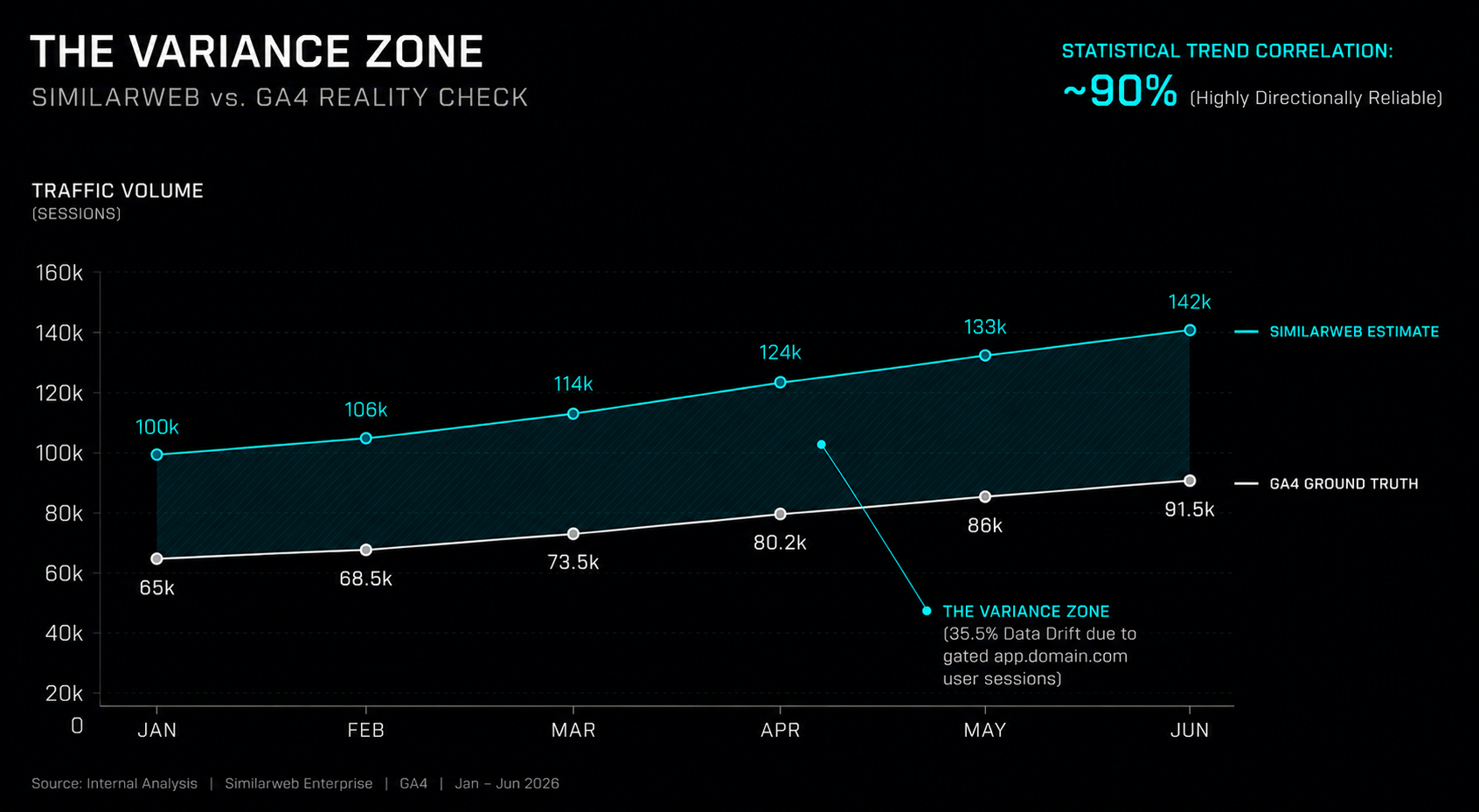
The Similarweb Estimate: ~140,000 monthly sessions; tracking a steady +25% MoM upward trend across desktop traffic.
The GA4 Ground Truth: 91,500 monthly sessions; actual organic and direct traffic velocity.
The Variance Zone: Similarweb overestimated the absolute traffic volume by roughly 35%.
Why does this data drift happen?
The target platform had a highly active power-user base operating behind a gated login dashboard (app.domain.com). Similarweb’s panel filters captured these heavy recurring user sessions on the root domain but couldn't completely isolate the non-indexed web-app behavior, structurally inflating the absolute session volume.
The Strategic Verdict: Is the data directionally reliable?
Anyone who has spent over five years working with market intelligence knows that absolute numbers in Similarweb are rarely dead accurate—and expecting them to be is a rookie mistake. However, they are highly directionally reliable.
While the absolute volume here was inflated by 35%, the slope of the growth curve and the channel distribution ratios (Direct vs. Organic Search vs. Paid Referral) mirrored the internal GA4 logs with a ~90% statistical correlation.
Advanced growth teams do not use market intelligence platforms to build financial accounting spreadsheets. We use them to detect directional shifts. In this case, we trusted the trend line, verified that their sudden traffic spike was driven by a newly launched programmatic SEO directory in France (not a temporary ad campaign), and scaled our own acquisition infrastructure with total confidence.
An Honest Similarweb Review: Is Traffic Estimator Accuracy Worth the Absurd Price?
Let’s drop the corporate diplomacy and deliver a raw, unedited Similarweb review. The elephant in the room is obvious: is this platform actually worth the eye-watering price tags that give CFOs a mild heart attack?
When it comes to Similarweb traffic estimator accuracy, we have to be brutal. If your project is a micro-business, a local service, or a fresh startup pulling fewer than 50,000 visits a month, close the tab and walk away. At low traffic volumes, panel data lacks the mathematical density to build a reliable model. The margins of error become catastrophic, and you won’t be analyzing a market—you’ll be analyzing digital hallucinations. Stick to your internal console and basic search tools.
But the moment your project matures into a mid-market B2B SaaS, a high-velocity E-commerce store, or an international performance agency, the ROI math flips completely. Similarweb stops being an analytics cost and becomes your primary risk-mitigation infrastructure.
It protects you from the single most expensive mistake in growth marketing: spending hundreds of thousands of dollars validating a channel, a funnel design, or a geographic market that your competitors already tested, failed at, and abandoned two quarters ago. You aren’t paying for spreadsheets; you are purchasing a map of the landmines your rivals already stepped on. It buys your team speed, absolute clarity, and an unfair strategic advantage. And in a volatile market, that is worth every single cent.
Recommended for you


 Jul 14, 2026
Breaking the AI Black Box: A Practical Generative Engine Optimization (GEO) Playbook Built on Raw Prompt Logs
Stop optimizing in the dark. Learn how to construct a custom relational data warehouse to decode how LLMs treat your brand, bypass flat-dump reporting limitations with raw prompt-response analysis, and translate hidden AI dialogue into a surgical GEO roadmap that outmaneuvers enterprise legacy giants.
 May 18, 2026
Competitive & Market Intelligence: The Hard-Core Guide to Unmasking Market Winners
Stop scaling in the dark. Learn how to extract raw competitor data from Similarweb, Ahrefs, and Semrush, and translate chaotic market analytics into explicit, high-impact tactical workflows that actually drive business growth in 2026.
 May 5, 2026
Market & Competitor Intelligence 2026: The "No-Bullshit" Guide for Growth Architects
If your competitor research doesn't end with a list of at least 10 high-probability hypotheses and a tactical plan to steal market share, you haven't done research. You’ve done creative writing. In 2026, we don't need more slides; we need more targets.
Software mentioned in this article
Post a comment
Comments
Recent News
Featured Software

David Vance
7/6/2026Finally, a marketer who understands that monthly data checks on third-party intelligence platforms are just chaotic noise. Your point about using this as a quarterly baseline for strategic planning is spot on–it’s the only way to filter out short-term ad campaign spikes and see the actual structural shifts in Share of Voice
Viktoria
6/20/2026My take: this article is a useful reminder that we work in a digital Wild West, where market intelligence is about direction rather than absolute precision. I especially liked the idea that competitor data should be taken with a grain of salt – not because it's useless, but because its real value lies in trends, ratios and shifts in behavior. Treating these numbers as exact truth is a recipe for disaster. Using them to spot opportunities and make smarter decisions is where the real advantage is. Definitely a valuable perspective for anyone working in growth or digital marketing.